Finding the perfect e-bike for women in 2025 can be a challenge with so many options available. The market is full of choices, but what really matters for your specific needs? This guide presents the best e-bikes for women, focusing on top favorites for every type of ride—from daily commutes around town to weekend adventures. We examine key features, performance, and offer crucial tips to help you find the ideal e-bike to suit your lifestyle and budget.
1. Understanding e-bike design specifically for women
When you're looking for an e-bike designed specifically for women, "women-specific" means far more than just a different color. It refers to crucial design changes that improve comfort, control, and safety for female riders. The most important factor is frame geometry. Manufacturers often design these frames with a shorter top tube (the tube that connects the handlebars to the seat post), which reduces the reach to the handlebars. This prevents the common problem of overextending, which can cause back, shoulder, and neck pain on longer rides. The most popular style is the step-through or low-step frame, which eliminates the high top tube. This makes getting on and off effortless, especially in stop-and-go city traffic or when wearing skirts or professional clothing.
Here are the most important design elements to pay attention to:
-
Frame geometry:
-
Low entry (step-through): Offers maximum user-friendliness. Ideal for recreational cyclists, commuters, and people with limited mobility.
-
Low-Step (or Mid-Step): A hybrid design that allows for easier mounting than a conventional frame, but retains more stiffness, which is good for sporty riding.
-
Overhang height: This is the distance from the ground to the top tube. Important tip: You should have at least 2.5 to 5 cm of space between your body and the top tube when you are standing over the bicycle.
-
-
Component size:
-
Saddles: Saddles specifically designed for women are usually wider at the back to better support the female pelvis.
-
Handlebar width: Often narrower to match the shoulder width and thus allow for better control.
-
Handle diameter: Some models have handles with a slightly smaller diameter for smaller hands.
-
Brake lever: Look for brake levers with adjustable reach so you can bring the lever closer to the handlebars for easier and safer braking.
-

2. The city commuter: Efficiency for every day
The "e-bike for all occasions" is the daily commuter bike for many women. This bike needs to be a reliable workhorse, prioritizing safety, comfort, and efficiency. The main goal is to get you to your destination reliably, comfortably, and cleanly. An upright riding position is essential in urban environments, as it provides good visibility of traffic and relieves strain on your back and wrists. The e-bike's motor should be smooth and predictable, offering assistance that helps you accelerate from a standstill without feeling jerky or overwhelming.Efficiency is also crucial, as you need a battery that can easily last a full day or even several days of commuting on a single charge.
For a truly practical commuter bike, integrated accessories are indispensable:
-
Key features for commuters:
-
Complete mudguards: These are crucial. They prevent water, mud, and road grime from splashing onto your clothes, ensuring you arrive at work clean and dry.
-
Integrated lighting: These lights are powered by the e-bike's main battery, so you never have to worry about charging them. They are essential for being seen by cars in all lighting conditions.
-
Luggage rack: A sturdy luggage rack is essential for attaching panniers. Pro tip: Carrying your load on your bicycle (rather than in a backpack) lowers your center of gravity and prevents a sweaty back, making the ride much more comfortable.
-
-
Must-haves for performance:
-
Puncture-proof tires: These tires have a reinforced layer that helps prevent flat tires from glass or sharp objects, saving you time and the hassle of roadside repairs.
-
Removable battery: This allows you to lock your bicycle outside and bring the battery inside for convenient charging and security.
-

3. Fitness and Touring: Covering Distances in Comfort
For women focused on fitness or long-distance touring, the "e-bike for every ride" is one designed for range and performance. These rides involve hours in the saddle, so efficiency and comfort are paramount. The most important technological feature in this category is the sensor. While cheaper bikes use a cadence sensor (which provides a simple on/off boost), fitness bikes should have a Torque sensor use. A torque sensor measures, how strong You pedal, and it provides proportional assistance. This feels intuitive, mimics natural cycling, and—most importantly—is far more efficient, significantly increasing your battery range. A lighter overall bike weight is also a major advantage, making the bike more responsive and easier to pedal should you need to ride without assistance or exceed the motor's speed limit.
Here's what you should prioritize when choosing a fitness or touring e-bike:
-
Components for maximizing range:
-
Torque sensor: As mentioned, this is the most important feature for a natural driving feel and greater range.
-
Large battery: Look for a battery with at least 500 Wh (watt-hours) or more. For touring, some bikes even support dual-battery systems.
-
Efficient engine: A 250W motor is often more than enough and usually more efficient than a high-performance motor, thus conserving the battery for moments when you really need it (e.g., on a steep hill).
-
-
Components for comfort and performance:
-
Multiple courses: A broad translation (e.g.Having 7 gears or more is crucial for tackling different terrain and maintaining a comfortable cadence.
-
Ergonomic handles and saddle: For long journeys, it's worth investing in improved grips that support your palms and a high-quality saddle.
-
Lighter frame: A lighter bike is simply more fun. Aluminum is the standard, but carbon fiber offers the best weight savings and vibration damping in this class.
-

4. All-Road and Adventure: Beyond the Asphalt
For women whose rides include gravel roads, forest tracks, and rough trails, an adventure or all-road e-bike is the perfect choice. These bikes are more robustly built than their city-oriented counterparts and give you the confidence to explore off the beaten track. The key feature is the tires: they are wider and have a more aggressive, knobby tread. This provides significantly more grip and stability on loose surfaces like dirt or gravel. Most all-road bikes also come equipped with a front suspension fork. This fork absorbs shocks from bumps, rocks, and roots, significantly increasing your comfort and, above all, your control of the bike, especially on descents. The motor of an adventure bike should also be considered; look for a model with higher torque (measured in Newton meters, Nm) to better tackle steep, loose climbs.
Consider these elements for your adventure-ready e-bike:
-
Key off-road components:
-
Wide knobby tires: Make sure you use tires that are at least 40C (40 mm) wide or wider.
-
Front suspension fork: A fork with 60 mm to 100 mm of "travel" (the amount it can compress) is ideal for smoothing out uneven roads.
-
Durable frame: The frame is designed to withstand more stress than a standard commuter bicycle.
-
-
Performance checklist:
-
Hydraulic disc brakes: These are a must for off-road driving. They offer far better braking power and modulation (control) than mechanical brakes, especially in wet or muddy conditions.
-
High-torque engine: An engine with 50 Nm of torque or more makes climbing steep hills seem almost effortless.
-
-
Driving tip: When you switch from asphalt to a gravel road, Let a little air out of your tires.Check the sidewall for the recommended pressure range (e.g., 35-55 PSI). Operating at the lower end of this range immediately increases your tire's contact patch, giving you better grip and a much smoother ride over bumps.

5. Top recommendation: The best lightweight e-bike for commuting and fitness
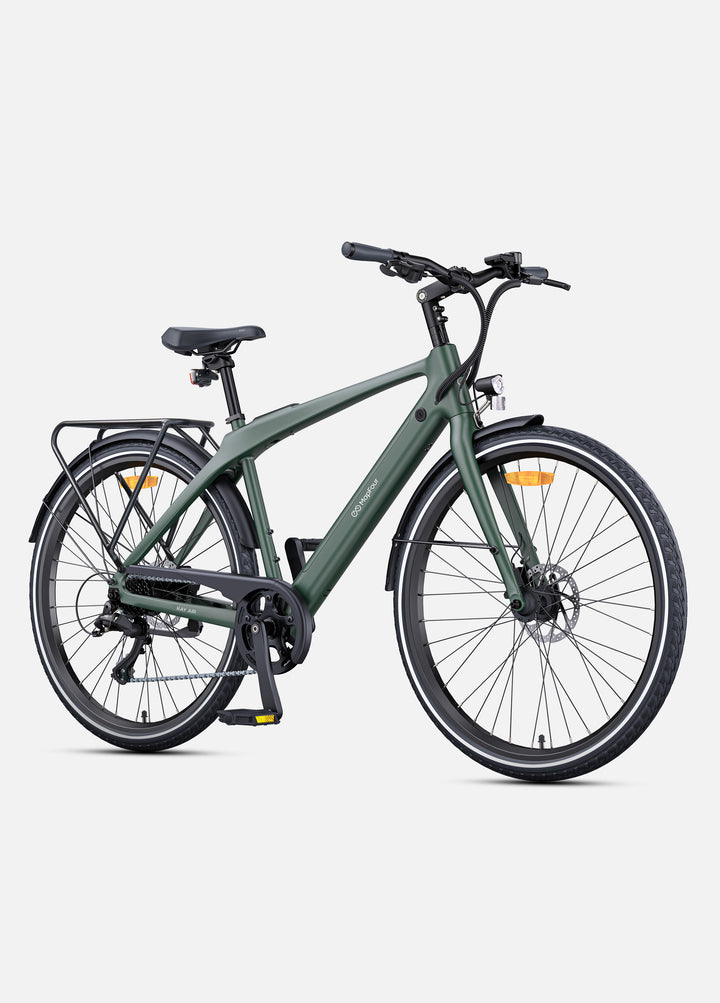
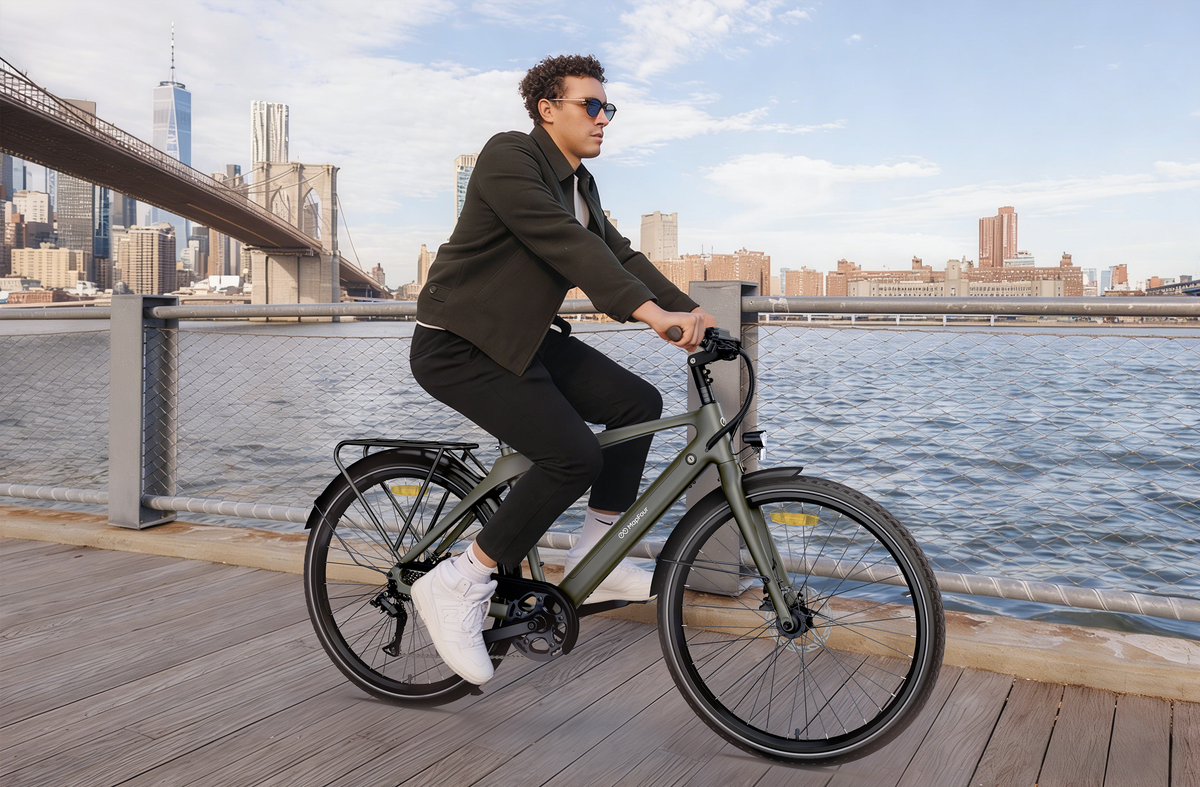
For female drivers seeking the ultimate blend of lightweight construction, long-distance performance, and advanced technology, this is the one. Mapfour Ray Air Our top recommendation. This e-bike redefines the category of "Best choice for your first carbon e-bike". Its main strength lies in its stunning Toray carbon fiber frame, manufactured using a sophisticated monocoque process.This makes the wheel with only 15.6 kg (34.39 lbs) Incredibly lightweight, yet offering natural shock absorption for an exceptionally comfortable ride. It's the perfect choice for women who might need to carry their bike up stairs or who value an agile, responsive feel. Marketed as the "lightest carbon e-bike with a 100km range," the Mapfour Ray Air delivers on that promise.
Here's an overview of what makes it our favorite:
-
Feather-light performance:
-
Motor: MIVICE M070 250W rear hub motor (40 Nm torque).
-
Battery: 36V 10Ah SAMSUNG, removable lithium-ion battery.
-
Reach: Up to 100 km on a single charge (when using PAS 1).
-
Top speed: 25 km/h.
-
-
A first-class, intuitive driving experience:
-
The Ray Air features a high-precision Torque sensorThis is a high-end feature that provides an incredibly smooth and responsive ride by instantly adjusting motor power to your pedaling effort. It feels like natural cycling, only easier.
-
-
Smart features and security:
-
Theft protection package: Includes integrated GPS tracking, motion detection and geofencing for complete peace of mind.
-
Visibility: Equipped with a front light and an innovative, environmentally friendly solar-powered rear light.
-
Display: A sharp LCD color display shows all important driving data.
-
-
Versatile fit and components:
-
It is equipped with versatile 700*38C tires and a SHIMANO 7-speed drivetrain. It is offered in two models: one with reliable mechanical disc brakes (and steel mudguards) and an improved version with powerful hydraulic disc brakes (and plastic mudguards).
-
It fits comfortably for a wide range of female riders, from 160 cm to 195 cm in height.
-

6. Core technology: How to choose a motor and sensor
Understanding the technology that powers your e-bike is the best way to ensure you get the riding experience you want. The two most important components are the motor and the sensor. There are two main types of motors: One hub motorThe rear hub motor, located in the center of the rear or front wheel, is the most common type. Rear hub motors are reliable, proven, and offer a powerful "push" that is ideal for most commutes and general use. Mid-engine It is located in the center of the frame, directly next to the pedals. Its advantage is that it utilizes the bicycle's gear system, making it exceptionally efficient when climbing very steep hills. Mid-drive motors are typically found on more expensive, high-performance, and off-road models.
The sensor is probably even more important for your everyday driving experience:
-
Sensor types (the “brain” of the bicycle):
-
Cadence sensor: This is a simple "on/off" switch.As soon as it detects that you are pedaling (cadence), it switches the motor to a preset level. This system is effective and affordable, but can feel jerky, especially at low speeds. There is often a slight delay when starting and stopping.
-
Torque sensor: This is a "smart" sensor. It measures, how strong You pedal, and instruct the motor to add a proportional amount of power. If you pedal lightly, it provides a little assistance. If you pedal hard to climb a hill, it provides a lot of assistance.
-
-
Why a torque sensor is an important quality feature:
-
Natural driving feel: The ride is intuitive and smooth. It feels like you're doing the work, only with "superpowers" in your legs.
-
Improved battery life: It is far more efficient, as it only supplies the energy you need at any given moment. actually need, it significantly extends the range of your battery compared to a cadence sensor that is always "fully on".
-
More secure control: The power delivery is immediate and predictable, giving you better control in tight situations.
-

7. Battery Secrets: Maximizing Range and Lifespan
Your e-bike's battery is its "fuel tank" and its most expensive single component. Knowing how to treat it will save you money and prevent range anxiety. A battery's capacity is measured in watt-hours (Wh), which is its voltage (V) multiplied by its ampere-hours (Ah). For example, a 36V 10Ah battery has 360 Wh. While a higher number (like 500 Wh or 600 Wh) generally means more range, the actual The distance you can travel is massively influenced by your driving habits.
Here are professional tips to get the most out of every load:
-
Here's how to maximize the range per charge:
-
Use lower PAS levels: Stay in Pedal Assist System (PAS) 1 or 2 as much as possible. Reserve the highest levels (4 or 5) only for steep hills or strong headwinds.
-
Use the circuit: When going uphill, shift into an easier gear, just like on a regular bicycle. This keeps your cadence high and prevents the motor from "struggling," which drains the battery quickly.
-
Check tire pressure: Properly inflated tires have lower rolling resistance. This is the easiest and free way to gain more range.
-
Drive smoothly: Avoid rapid, jerky acceleration from a standstill.
-
-
Cost-saving tips for battery care:
-
Storage: If you are not going to be riding for several weeks, do not store the battery at 100% or 0%. Store it partially charged, ideally between 40% and 80%.
-
Temperature: Lithium-ion batteries hate extreme temperatures. Never leave your battery in a hot car or a freezing garage. Charge and store it indoors at room temperature.
-
Load: Don't leave it plugged in for days. Unplug it as soon as it's fully charged.It is also perfectly fine to "refresh" it with partial charges.
-

8. Smart Buyer's Guide: Find your size, try it on, and save money
You've narrowed down your choices; now it's time to buy. Finding the right size is the most important step. A bike that's too big or too small is uncomfortable and unsafe. While manufacturer charts (like "fits heights from 160 cm to 195 cm") are a good starting point, everyone's body is different. The best way to ensure a good fit is to take a test ride. This is your most important tool. You wouldn't buy a car without test-driving it; don't buy an e-bike without a test ride either.
Here's what you should pay attention to during your test drive and how you can save money:
-
Your checklist for the test drive before buying:
-
The stand test: Stand over the wheel. Can you comfortably stand with both feet flat on the ground?
-
The lifting test: Is the bike's weight manageable? Try lifting the front wheel. Imagine you had to push it over a curb or lift it onto a bike rack.
-
The performance test: Start from a complete standstill. How does the motor engage? Is it smooth (like with a torque sensor) or jerky (like with a cadence sensor)?
-
The hill test: Find a hill. Ride up it using different levels of assistance to feel the power of the motor.
-
The brake test: Test the brakes from a safe, medium speed. Do they feel secure and powerful?
-
-
This is how you get the best value:
-
Best time to buy: The bicycle industry is seasonal. Important tip: You can often find the best discounts in autumn and winter. Stores clear out the current year's models to make room for the new range that arrives in spring.
-
Direct-to-consumer brands: Brands that sell exclusively online (like Mapfour) often offer more features for the same price, as they eliminate the middleman.
-
Check for funding opportunities: Many cities and governments offer "green" incentives or subsidies for purchasing an e-bike as an alternative to a car. A quick search in your region could save you hundreds of euros.
-
Important questions answered
What is the biggest mistake women make when buying an e-bike? The most common mistake is buying a bike that's too heavy. A very heavy e-bike (over 25 kg) is difficult to maneuver at low speeds, hard to push up stairs, or difficult to lift onto a car rack. Always check the weight.
How fast can e-bikes for women go? In most parts of Europe, the assistance provided by e-bikes is legally limited to 25 km/h. In the USA, Class 1 and 2 e-bikes are limited to 20 mph (32 km/h). This is more than fast enough for safe and efficient commuting.
Is a torque sensor really worth the extra cost? Absolutely. It's the most important upgrade for the "feel" of an e-bike. It provides a safer, more intuitive ride that feels like natural cycling, and significantly improves the efficiency and range of your battery.
Choosing the right e-bike will change your riding experience.Therefore, test several and find the model that feels like an extension of yourself.