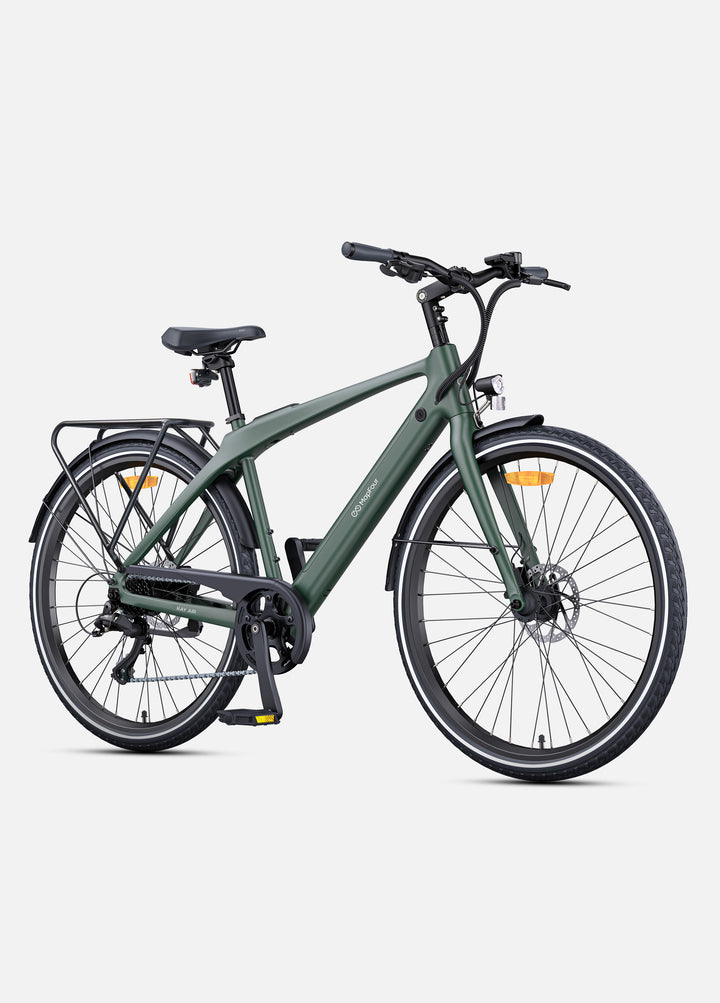
Choosing the right e-bike motor is the most important decision you'll make. It determines the riding experience, the cost, and the maintenance requirements of your bike. The market is dominated by two types: hub motors and mid-drive motors. This guide breaks down the key differences and goes beyond simple technical specifications to help you understand which technology truly best suits your specific needs, riding style, and budget. Let us find your perfect partner.
1. Performance perception and driving experience
The most immediate difference between hub and mid-drive motors is the riding experience. A mid-drive motor is located in the center of the bicycle at the bottom bracket (where you pedal) and delivers power directly to the drivetrain. This means the motor's power is transferred through the bicycle's gears. The result is an incredibly natural and intuitive feeling, often described as having "super-strong legs." Because it utilizes the bicycle's gears, it can operate at its optimal cadence, making it highly efficient. These motors almost exclusively use torque sensors that measure how strong You pedal, and it provides proportional assistance. The harder you pedal, the more power it delivers.
A hub motor is located in the center (the hub) of the front or rear wheel. It delivers power directly to the wheel, independent of the bicycle's gears. This creates a distinct feeling of "pushing" (from the rear wheel) or "pulling" (from the front wheel). Many entry-level hub motors use a cadence sensor, which simply turns the motor on when you start pedaling and off when you stop. However, high-end hub motors today use advanced torque sensors to provide a much smoother, more responsive ride, comparable to that of a mid-drive motor.
-
Feeling with the mid-engine:
-
Natural and intuitive, as if one's own strength is amplified.
-
Power is transferred via the bicycle's gears, ideal for different speeds.
-
Uses a torque sensor for seamless, responsive support.
-
It feels balanced because the weight is low and central.
-
-
The feeling when using a hub motor:
-
A distinct feeling of "push" or "pull".
-
Easier, more like an effortless boost.
-
Can use a simple cadence sensor (on/off feel) or a premium torque sensor (smooth and responsive).
-
Many hub motors are compatible with a throttle grip, which makes it possible to move without pedaling.
-

2. Acquisition costs and long-term affordability
For most buyers, budget is a crucial factor, and this is where hub motors have a clear advantage. Hub motor technology is more mature, easier to manufacture, and less complex to integrate into a standard bicycle frame. This results in a significantly lower purchase price. Because the motor is a self-contained unit within the wheel, it doesn't require a highly specialized, reinforced frame. This simplicity makes e-bikes with hub motors the undisputed king of value for money, offering riders most of the benefits of e-biking at a much more accessible price.
Mid-engines are a premium technology. The engines themselves are complex, with intricate internal gearing.Most importantly, they require a proprietary, specially designed frame to house the motor unit, which drastically increases manufacturing and design costs. Brands like Bosch, Shimano, and Brose dominate this market, and their engineering expertise comes at a price. While the initial investment is higher, some users argue that the performance benefits justify the cost, but for the average cyclist, the value proposition of a hub motor is hard to ignore.
-
Cost savings with hub motors:
-
Lower purchase price due to simpler manufacturing.
-
They can be installed in more traditional and less expensive bicycle frames.
-
The replacement costs are lower because usually only the wheel is replaced, not a complex, integrated frame component.
-
-
Key considerations regarding mid-engine costs:
-
Significantly higher purchase price.
-
Proprietary motors and batteries can be very expensive to replace after the warranty expires.
-
Often associated with higher-quality, more expensive bicycle models.
-

3. Maintenance, durability and repairs
This is a critical, often overlooked dimension that directly impacts your wallet. A hub motor is a self-contained, sealed unit. This design is incredibly robust and durable. Because the motor's power is transferred directly to the wheel, it completely bypasses the bicycle's main drivetrain (chain, cassette, and chainring). This means these components only have to withstand the stress of your pedaling, not the motor's. As a result, your drivetrain components will last significantly longer, just like on a regular bicycle. The only maintenance quirk is that changing a flat tire can be slightly more complex due to the motor cable. However, a pro tip is to look for bikes with a quick-release connector near the wheel, which simplifies removal.
Mid-mounted engines, by design, transmit the full power of the engine. and Your own pedaling power is transferred through the chain and cassette. This means that high-performance e-MTBs experience much faster chain and cassette wear than any other type of bicycle; sometimes a replacement is necessary after only 1,500 km. This results in an ongoing, costly maintenance cycle. On the plus side, changing a flat tire is as easy as on a regular bicycle, since the wheels are standard components.
-
Hub motor maintenance profile:
-
Advantage: Extremely low wear on the drivetrain, saving money on chains and cassettes.
-
Advantage: The motor is a simple, sealed unit that is highly reliable ("install and forget").
-
Disadvantage: Changing a tire may require an additional step to disconnect the motor cable.
-
-
Mid-engine maintenance profile:
-
Advantage: Standard wheels make changing tires very easy.
-
Disadvantage: It causes significantly faster wear and tear on chains and cassettes, leading to frequent and costly replacements.
-
Disadvantage: The engine unit is complex and, in case of a defect, expensive to maintain or replace.
-

4.Efficiency, battery range and power consumption
How far can you go on a single charge? That often depends on the motor's efficiency. A mid-drive motor has a crucial advantage: it utilizes the bike's gears. This allows the motor to remain in its optimal RPM range, whether you're climbing a steep hill in a low gear or cruising along a flat road. Just like a car engine, an electric motor is most efficient when it's not stalled or idling. By letting you shift gears, the mid-drive motor stays in its highly efficient range, which can result in greater battery range, especially on hilly terrain.
A hub motor, on the other hand, is a single-speed system. Its efficiency is directly tied to the wheel's speed. On a very long, slow, and steep climb, a hub motor may be forced to operate outside its optimal efficiency range, generating more heat and draining the battery faster. However, this is often exaggerated. For the vast majority of rides, which include flat terrain and moderate hills, a well-designed hub motor can be just as efficient as, or even more efficient than, a mid-drive motor. When cruising along at a steady speed, a gearless hub motor has very little internal friction and can be exceptionally efficient.
-
Maximizing range with a mid-mounted motor:
-
Utilize the full range of gears to remain within the engine's most efficient RPM range.
-
This is the most efficient system for tackling very steep or long climbs.
-
Premium torque sensors waste less energy because they only deliver what you need.
-
-
Facts about the efficiency of hub motors:
-
Extremely efficient for driving at a constant speed on flat or hilly terrain.
-
May be less efficient on long, slow climbs with high torque.
-
The overall range often depends more on the battery size (Ah) and the assistance level (PAS) than on the motor type itself.
-

5. Ideal terrain and main purpose
The most important question you need to answer is: "Where will I be riding?" Your answer will lead you directly to the right motor. Mid-drive motors are the undisputed champions for performance-oriented, technical riding. Their ability to utilize the bike's gears makes them kings of the mountains. They can tackle incredibly steep climbs without overheating. Their central, low weight distribution is crucial for the balance and handling required in technical mountain biking (eMTB). If your rides involve long climbs or challenging off-road trails, a mid-drive motor is the right tool for the job.
For the other 95% of all e-bike rides, however, a hub motor is often the more practical and logical choice. For commuting in the city, running errands, or leisurely rides on bike paths, a hub motor offers all the power you need. A rear hub motor provides a confident "push" that's perfect for accelerating from a standstill. It excels in stop-and-go city traffic and on flat or hilly terrain. Because the system is so reliable and requires little maintenance, it's the perfect workhorse for everyday transport and leisure.
-
Choose a mid-drive motor if:
-
You are a serious mountain biker who conquers technical trails.
-
Her commute includes extremely steep hills (e.g., San Francisco).
-
You are a performance enthusiast looking for that "bicycle-like" feeling.
-
They undertake long-distance tours where maximum climbing efficiency is crucial.
-
-
Choose a hub motor if:
-
You are a city commuter or urban rider.
-
They primarily ride on cycle paths, paved roads or gravel roads.
-
You are looking for a low-maintenance, more affordable and highly reliable e-bike.
-
They appreciate the option of a throttle grip for pedal-free assistance.
-

6. Design, weight distribution and aesthetics
How a motor is integrated affects the balance and appearance of the bike. A mid-drive motor, by its very design, places a heavy, dense component at the lowest, most central point of the bicycle. This is the gold standard for weight distribution. The result is a bike that feels planted, stable, and well-balanced—another reason why it's preferred for technical terrain. The aesthetic drawback is that a large, bulky bottom bracket area and a thick downtube are required to accommodate the motor and battery. These bikes often practically scream that they're electric.
Hub motors, especially rear hub motors, offer a much more discreet design. A compact rear hub motor can be hidden behind the cassette, making the e-bike look almost identical to a conventional, non-electric bicycle. This is a big plus for riders who want a high-tech bike that looks clean and traditional. The trade-off is that the weight is concentrated in the rear wheel. While a professional cyclist might notice this, the average rider won't. In fact, the rearward weight distribution can even improve the motor's traction.
-
Important design aspects (mid-engine):
-
Advantage: Perfect weight distribution (low and central).
-
Advantage: It feels balanced and stable, especially during aggressive driving.
-
Disadvantage: Creates a powerful look at the bottom bracket.
-
Disadvantage: Visually, it's very obvious that it's an e-bike.
-
-
Important design aspects (hub motor):
-
Advantage: Enables a "stealth" design that looks like a normal bicycle.
-
Advantage: Allows for a cleaner, more traditional frame aesthetic.
-
Disadvantage: The weight is concentrated at the rear (or front).
-
Disadvantage: This can make the wheel appear "rear-heavy" when lifting, although this is rarely noticeable while riding.
-

7. Our top recommendation: A case study of hub motor excellence
While mid-drive motors are excellent for extreme mountaineering, modern hub motor technology has evolved to offer a first-class, lightweight and highly intelligent experience that is the perfect solution for the vast majority of riders.At Mapfour, we have focused on perfecting this technology, and our flagship, the Mapfour Ray AirIt redefines what an e-bike with a hub motor can achieve. It's our "Best Choice for the First Carbon E-Bike" and the "Lightest Carbon E-Bike with a 100 km Range." With amazing 15.6 kg It is lighter than many conventional bicycles, making it effortlessly portable.
What makes the Ray Air special is how it combines the best of both worlds. It uses a powerful and quiet MIVICE M070 250W rear hub motor (40 Nm), but combines this with a highly developed Torque sensorThis is a crucial detail: it delivers the smooth, intuitive, and responsive riding experience previously reserved exclusively for expensive mid-drive motors. It perfectly adapts to your pedaling effort and eliminates the jerkiness of simple hub motors. This advanced system, combined with premium construction, makes it the superior choice for smart, modern mobility.
-
Highlights of the Mapfour Ray Air:
-
Premium frames: A monocoque frame made of Toray carbon fiber that absorbs road vibrations for a comfortable ride.
-
Enormous range: 100 km range (on PAS 1) with a lightweight, removable 36V 10Ah SAMSUNG battery.
-
Smart and safe: Features include GPS tracking, motion detection, geofencing and a unique solar-powered rear light.
-
Premium components: It uses a SHIMANO 7-speed drivetrain and is available in two versions with either 160 mm mechanical or hydraulic disc brakes.
-
Versatile fit: The 700*38C tires are perfect for speed and comfort on asphalt or light gravel and are suitable for riders from 160 cm to 195 cm tall.
-
The Mapfour Ray Air proves that for commuting, fitness and pure riding pleasure, a high-tech lightweight hub motor is the smarter, lighter and more durable choice.

8. Powertrain Integration and Compatibility
One final technical point concerns the motor's compatibility with the rest of the bicycle. As mentioned, a mid-drive motor powers the chain. This means it's incompatible with certain drivetrains. For example, you can't use an internal gear hub (like a Shimano Alfine or Rohloff) with most standard mid-drive motors. They are limited to a standard derailleur system, which is more prone to damage and requires frequent adjustments.
Hub motors offer far greater flexibility because they operate independently of the drivetrain. While a rear-wheel motor still uses a standard derailleur system, a front wheel motor It leaves the entire rear drive system completely untouched. This means you could theoretically combine a front-wheel motor with an internally geared hub in the rear wheel, creating an incredibly robust, low-maintenance, year-round commuter machine. This modularity is a key advantage of hub systems. Furthermore, hub motors are the only system that can be easily retrofitted to an existing bicycle, although for safety and reliability reasons, we recommend a professionally built e-bike.
-
Hub motor compatibility:
-
Advantage: The engine is a separate system from the drivetrain.
-
Advantage: This modularity offers greater flexibility in component selection.
-
Advantage: Enables the use of hub gears (with front motors).
-
Advantage: The motor system can be replaced or upgraded without affecting the rest of the bicycle.
-
-
Mid-drive motor compatibility:
-
Disadvantage: It specifies a particular, compatible derailleur system.
-
Disadvantage: Incompatible with most hub gears.
-
Disadvantage: The engine, frame and crankset are an integrated, proprietary system, making modifications impossible.
-

Your most important questions about the engine answered
1. Can a hub motor handle hills? Absolutely. While mid-drive motors are the specialists for extreme mountain climbing, a high-quality rear hub motor with good torque (e.g., 40 Nm or more) can easily propel you up the moderate hills and inclines found in most cities and on cycle paths.
2. Is a torque sensor or a cadence sensor better? A torque sensor is far superior for driving feel. It measures, how strong They pedal, and it offers proportional, smooth support. That's precisely why premium hub motors like the one in the Mapfour Ray Air use such a sensor. A cadence sensor only measures, whether They kick in, leading to an abrupt drop in power output.
3. Which engine is easier for complete beginners? Hub motors are often easier for new riders. They are very easy to use (simply pedal and go), require much less maintenance, and you get used to the "push" sensation very quickly. They offer effortless assistance – exactly what most new e-bike riders are looking for.
Ultimately, the best engine is the one that perfectly suits your daily driving, budget, and performance requirements.
Would you like to know which engine system is most efficient for your specific route profile, or do you have questions about the range with different loads?