Buying an e-bike is a significant investment in your mobility, freedom, and health. But with hundreds of models, motor types, and battery sizes, the market can seem overwhelming. This guide will help you navigate the options. We examine the eight crucial factors—from primary use and motor technology to long-term value and safety—to ensure you find the perfect e-bike for your specific needs.
1. Define your purpose: What type of driver are you?
Before you even look at a single technical specification, the most important consideration is your primary use. An e-bike designed for rough trails is a poor choice for daily commuting in the city, and vice versa. Defining your purpose immediately narrows down the options and ensures you only pay for features you'll actually use. A clear answer at this point will guide all subsequent decisions.
-
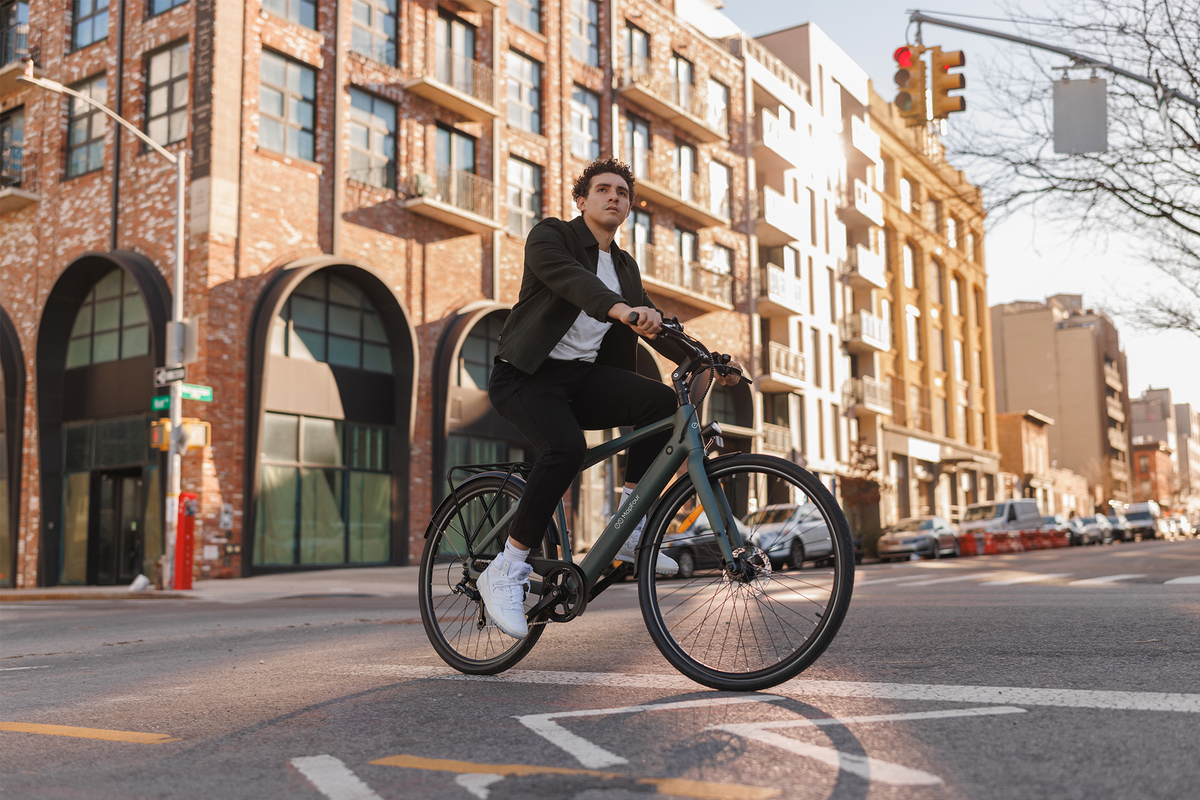
Daily commute: You need reliability and practicality. Look for bikes with pre-installed mudguards to keep you dry, integrated lights for safety, and a rack for bags or shopping. Comfort is crucial, so an upright riding position is often preferred. Range is important, but it only needs to be sufficient to comfortably cover your round trip.
-
Riding on trails (E-MTB): This requires durability. A suspension fork (hardtail) or full suspension (full suspension) is essential. A mid-drive motor is highly recommended due to its superior torque and better balance on steep climbs. Knobby tires and a robust frame are indispensable.
-
Fitness and leisure: If your goal is exercise, you want a bike that rewards your effort. A lightweight frame and a responsive torque sensor are crucial here. The motor is there to help you on inclines or extend your ride, not to do all the work for you.
-
Use and load transport: If you're replacing your car for errands or deliveries, you'll need a workhorse. Look for a cargo e-bike with a long wheelbase, a powerful motor (hub or mid-drive), a large battery (or the option for two batteries), and a high payload capacity for heavy loads.

2. The “Engine”: Understanding Motors and Sensors
The motor and sensor form the heart of the e-bike. The motor provides the power, while the sensor tells it when and how much power to deliver.
-
Motor type (hub motor vs. mid-drive motor):
-
Hub motors: These are located in the hub of the rear wheel (most commonly) or the front wheel. They are generally more affordable, very reliable, and require little maintenance. They are excellent for flatter terrain and general commuting.
-
Mid-engines: These are located in the center of the frame, directly by the pedals. This design transfers power directly to the drivetrain (the chain), which is more efficient when climbing steep hills. It also centers the weight, making the bike feel more balanced and natural, similar to a conventional bicycle.
-
-
Sensor type (cadence vs. torque): This is a crucial detail.
-
Cadence sensors: These function like a simple "on/off" switch.As soon as you start pedaling, the motor delivers a preset power level based on your assistance setting. This can sometimes feel jerky or as if the bike is "running away" with you.
-
Torque sensors: This is a more advanced, "intelligent" system. It measures, how strong You pedal, and it delivers power proportionally to your effort. If you pedal lightly, there is little assistance. If you pedal hard on a hill, it delivers more power. Pro tip: Always take a test ride on a bike with a torque sensor. The smooth, intuitive, and responsive ride feel is often a crucial factor that dramatically improves the riding experience.
-

3. The “fuel tank”: Battery range and charging
"Range anxiety" is a major concern for first-time buyers. The most important metric here is... Watt-hour (Wh)Think of this as the size of the "fuel tank." It's calculated by multiplying volts (V) by ampere-hours (Ah). A 36V 10Ah battery has 360Wh. A 48V 10Ah battery has 480Wh. More Wh generally means more range.
-
Realistic range estimate: Don't blindly trust the advertised "maximum range." This figure is usually achieved in the lowest assist mode (PAS 1), on flat terrain, and with a light rider. Your actual range will be affected by hills, wind, your weight, the assist level, and frequent stops. For most riders, a 400Wh to 500Wh battery is more than sufficient for daily riding.
-
Charging time: Most e-bike batteries take 4 to 8 hours for a full charge. If you commute daily, this can easily be done overnight. Look for removable batteries, which are much more convenient to charge indoors than having to take the entire bike inside.
-
Battery care tip: To maximize the lifespan of your expensive lithium-ion battery (often 3 to 5 years), you should follow two rules. First, avoid storing it in extreme temperatures (such as in a hot car or an ice-cold shed). Second, for long-term storage, it's best to keep the battery at a charge level of 40% to 80%, rather than at 100% or 0%.

4. Components and comfort: Brakes, gearshift and suspension
An e-bike is heavier and faster than a regular bicycle, which places additional demands on its components. Don't overlook these mechanical parts.
-
Brakes: This is your most important security feature.
-
Mechanical disc brakes: These are operated via a steel cable, just like conventional bicycle brakes. They are effective and easy to maintain.
-
Hydraulic disc brakes: These use brake fluid in a closed line, similar to the brakes of a car. Pro tip: Always choose hydraulic brakes if your budget allows. They offer significantly more braking power with less effort, are more reliable in wet weather, and self-adjust as the pads wear.
-
-
Gear shift (drive): You don't need 21 gears on an e-bike. The motor does most of the work. A reliable system with 7, 8, or 9 gears is perfectly adequate for most rides, including hills.
-
Suspension: A suspension fork at the front (on a "hardtail") absorbs shocks from the road and makes your ride much more comfortable, especially for your wrists and shoulders. Full suspension (front and rear) is generally only necessary for serious off-road mountain biking.
-
Tires: Wider tires (38c or more) offer more comfort, stability, and traction than narrow road bike tires. Look for tires with integrated puncture protection to avoid the hassle of flat tires.

5. A top choice for quality and innovation: Mapfour
If you are looking for a brand that effectively combines many of these high-end features, Mapfour is a top choice.
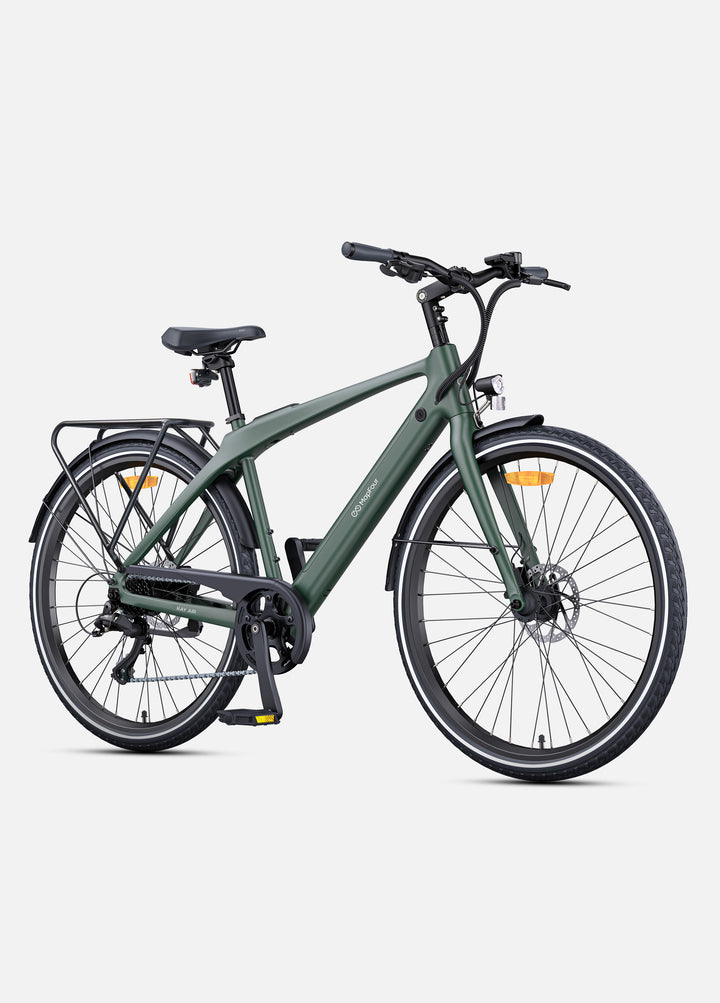
Their focus on lightweight, efficient design is clearly evident in the Mapfour Ray Air, an ideal choice for their first carbon e-bike. It addresses many key aspects simultaneously: at just 15.6 kg (34.39 lbs), it's ultralight. This is achieved through its monocoque frame made of Toray carbon fiber, which is not only light but also offers excellent shock absorption for a smoother ride. In terms of range, the removable 36V 10Ah Samsung battery delivers an impressive 100 km on a single charge (in PAS 1).
It features a highly responsive torque sensor paired with a quiet MIVICE 250W rear hub motor (40 Nm torque) for a smooth, natural riding experience up to the 25 km/h speed limit. It's also packed with modern, intelligent anti-theft features such as GPS tracking, motion detection, and geofencing. Mapfour thoughtfully offers the Ray Air in versions with either hydraulic or mechanical disc brakes and a 7-speed Shimano drivetrain, allowing for customization to suit rider preferences. Designed for a wide range of rider heights (160 cm to 195 cm), the bike includes practical accessories such as mudguards and a solar-powered rear light. This integration of a lightweight carbon frame, long-lasting battery, and intuitive torque sensor makes it a benchmark for quality.

6. Legal aspects: EU e-bike regulations (pedelecs vs. S-pedelecs)
This is a crucial consideration, as European regulations are standardized and define what an "e-bike" truly is. Unlike the US "class" system, EU rules primarily distinguish between two categories, which has a significant impact on where and how you are allowed to ride.
-
L1e-A “Pedelecs” (The 25 km/h standard):
-
This is the most widespread type of e-bike in Europe and is treated legally exactly like a conventional bicycle.
-
Motor assistance: The motor provides support only if you pedalThis is called pedal assist.
-
Speed cut-off: The support It must shut off at 25 km/h.You can pedal faster, but then the motor won't help anymore.
-
Power limitation: The motor must have a maximum rated continuous power output of 250 watts have.
-
Pushing aid: A "push assist" mode (a button that helps to push the bike) is allowed up to 6 km/h.
-
The advantage: No driver's license, insurance, or helmet is required (although a helmet is always strongly recommended). Most importantly, you are allowed to use all bike paths.
-
-
L1e-B “S-Pedelecs” (The 45 km/h fast e-bikes):
-
These are e-bikes that provide support up to... 45 km/h offer.
-
Legal classification: The crucial point is that these not They are considered bicycles. Legally, they are classified as mopeds or light motor vehicles.
-
Strict requirements: To ride such a bike, must You have the following:
-
A specific vehicle type approval.
-
A mandatory liability insurance.
-
A visible insurance license plate.
-
A valid driving licence (e.g. class AM or B).
-
A helmet suitable for mopeds (not just a simple bicycle helmet).
-
-
Important consideration: S-Pedelecs are strictly prohibited on most cycle paths. You have to ride it on the road alongside cars. When buying one, you have to choose between the freedom of a 25 km/h pedelec and the speed of a 45 km/h moped.
-

7. Practicality: Weight, portability and safety
Consider the everyday logistics of owning an e-bike.
-
Total weight: E-bikes are heavy, often weighing 20 to over 30 kg. If you live in an apartment and have to carry your bike up the stairs, this is an important consideration. A lighter bike is often more expensive, but much more convenient for everyday use.
-
Portability: If your commute involves a train journey or you live in a small space, a folding e-bike could be the perfect solution. While you might compromise on ride quality, you gain unparalleled convenience when it comes to storage and transport.
-
Security: E-bikes are a popular target for thieves. Within your budget must It should include a high-quality lock. Practical tip: Never rely on a cheap cable lock. Use at least a sturdy U-lock or a high-security folding lock and secure the frame (and ideally the rear wheel) to a solid, immovable object.
-
Intelligent security: Some modern e-bikes have integrated safety features such as GPS tracking or alarm systems with motion detection, which can provide additional security.

8. Long-term value: Budget, warranty and maintenance
Finally, consider the total cost of ownership, not just the original purchase price.
-
The budget: A very cheap e-bike (under €800) might seem like a bargain, but often uses inferior components that wear out quickly and result in high repair costs. The "sweet spot" for a reliable, quality e-bike often starts at around €1,500 and goes up from there.
-
Guarantee: A good warranty is a sign that the manufacturer stands behind their product. Look for at least a one-year warranty on the electrical components (motor, battery, controller) and a multi-year warranty on the frame.
-
Maintenance: E-bikes require regular maintenance, just like a normal bicycle, but with a bit more complexity.Chains and brake pads wear out faster due to the additional force and weight. Money-saving tip: Learn to perform basic maintenance yourself. Simple tasks like cleaning and lubricating the chain, checking tire pressure, and changing brake pads can save you hundreds of euros in workshop fees and dramatically extend the lifespan of your e-bike.
Your most important questions answered
1. Q: How much range do I really need? A: For most city commutes (under 15 km round trip), a standard 400Wh battery is more than sufficient, even with high assistance. Only choose large 600Wh+ batteries if you regularly plan trips of over 50 km or need to tackle extreme inclines.
2. Q: Is a mid-drive motor always better than a hub motor? A: Not necessarily. Mid-drive motors are technically superior for steep climbs and feel more "natural." However, a high-quality rear hub motor is extremely reliable, requires little maintenance, and offers a powerful "push" that many commuters love for quickly getting up to speed.
3. Q: How can I extend the lifespan of my e-bike battery? A: Three things: Avoid storing it in extreme heat or cold. Try not to let it run down completely to 0% too often. And if you're not going to use the bike for several weeks, store the battery with a charge of 40% to 80%, not at 100%.
Armed with this knowledge, you are now ready to find the e-bike that will truly transform your riding experience.