Choosing the right e-bike size is the most important decision for comfort, control, and safety. A poorly fitting bike is difficult to handle and can lead to tension or injury. This guide goes beyond simple size charts. We examine the eight crucial dimensions you need to consider—from frame geometry to adjustability—to ensure your new e-bike feels like a perfect extension of your body.
1. Understand the basic frame geometry
Before you pay attention to manufacturer designations like "Small" or "Medium," you need to understand the numbers that define a bicycle's fit. A bicycle's geometry chart is its DNA. Focusing on these measurements is a professional technique for ensuring a perfect fit, even when buying online. The most important figures are not just the seat tube length, but how the frame positions your body.
-
Seat tube length: This is the traditional measurement for size, taken from the center of the bottom bracket to the top of the seat tube. Although it determines the frame size (e.g., 17 inches), it is less important today than other measurements.
-
Effective top tube length (ETT): This is the horizontal distance from the head tube to the seat tube. This measurement is critical because it determines the length of your "cockpit"—how far you have to stretch to reach the handlebars. A short ETT (head tube length) results in an upright, relaxed ride, while a long ETT puts you in a more aggressive, aerodynamic position.
-
Reach: This is the modern standard for determining frame size, especially for mountain bikes and performance bikes. It measures the horizontal distance from the center of the bottom bracket to the center of the head tube. The reach tells you how "roomy" the bike feels when you're standing on the pedals.
-
Stack: This is the vertical distance from the bottom bracket to the head tube. A high stack value means the handlebars are higher, allowing for a more comfortable, upright riding position and reducing strain on your back and neck. A low stack creates a more "bent-over" position for increased speed.

2. The crucial role of the overhang height
Standover height is the most important measurement for your safety and confidence. It's the vertical distance from the ground to the top of the top tube. If you need to stop suddenly and jump forward off the saddle, you need enough space to land with both feet flat on the ground without hitting the frame. An e-bike is heavier than a regular bicycle, which makes dismounting suddenly more difficult and increases the importance of this measurement.
-
Here's how to measure yourself: This is a crucial skill. Stand barefoot with your back against a wall. Place a large, bound book between your legs and push it firmly upwards to simulate a bicycle saddle. Measure the distance from the top of the book's spine to the floor. This is your actual stride length, which is often 5–10 cm longer than your trouser length.
-
The distancing rule:
-
Commuter/hybrid bikes: Look for a bicycle with a standover height of at least 2.5–5 cm (1–2 inches). less is your stride length.
-
E-mountain bikes: Here you need significantly more clearance to move around technical terrain. Aim for 7.5–12.5 cm (3–5 inches) or more.
-
-
Money-saving tip: Checking this single measurement can save you the massive cost and hassle of having to return a bicycle that would be physically dangerous for you to ride. Step-through frames largely eliminate this problem and are a fantastic choice for beginners or people with limited mobility.

3. Matching the e-bike type to your riding style
The "right size" is not universal; it depends on the Intended use of the bicycle. The geometry of an e-mountain bike differs radically from that of an e-commuter bike. The sizing for one type cannot be applied to the other. You must first decide, How You want to drive, and then find the right size for that category.
-
E-commuters & Hybrid bikes: Here, the focus is on comfort and visibility. You'll prefer a more upright riding position, so look for bikes with a higher stack and a relatively shorter reach or top tube. This position allows you to comfortably observe traffic and reduces strain on your back, neck, and wrists.
-
E-mountain bikes (e-MTBs): This is all about handling and control on the trails. Modern e-MTBs are sized by their reach, and riders often choose the size based on their desired riding style. A longer bike (one size larger) offers more stability at high speeds, while a shorter bike (one size smaller) is more playful and easier to maneuver in tight corners.
-
E-racing bikes: Sizing is most precise here. The focus is on aerodynamic efficiency and power transfer. The fit is aggressive, and even a small error in size can lead to discomfort and loss of power on long rides.
-
E-cargo bikes: The fit here is crucial for stability when transporting loads. These bikes often have very low standover heights and long wheelbases. Sizing is generally more flexible and adaptable to accommodate different riders.

4. More than just height: Your proportions
Manufacturers' size charts that only use height are a starting point, but often inaccurate. They assume that everyone has "average" proportions. In reality, two people who are both 1.83 m tall can require completely different frame sizes if one person has long legs and a short torso, and the other has short legs and a long torso.
-
Stride length vs. body height: As mentioned previously, your stride length is the most important factor for standover height and saddle height. This measurement is far more reliable than your overall height.
-
Ape Index: This is a simple test of your proportions. Measure your arm span (from fingertip to fingertip) and subtract your height from that.
-
Positive index (range) > Size): They have long arms and a relatively longer torso. They will probably feel more comfortable on a bicycle with a longer reach or top tube.
-
Negative index (range) < Size): They have shorter arms and a relatively shorter torso. A bicycle with a shorter reach will feel more comfortable; they should avoid long frames.
-
-
Interesting facts: A "medium" bicycle from one brand will fit differently than a "medium" bicycle from another brand. Always use the geometry table. Use your stride length for standover height and your ape index to assess whether you need a "longer" or "shorter" wheel within your size range.

5. How to read and use manufacturers' size charts
The size chart on the manufacturer's website is your best tool. Reading it correctly will help you choose the perfect bike online and save you expensive return shipping costs.
-
Step 1: Find the table: Go to the specific product page of the e-bike you want. Do not use generic third-party size calculators.
-
Step 2: Comparison: Find your height and, if specified, your stride length in the table. Often you will end up in the "overlap zone" between two sizes (e.g., you are 1.78 m tall and the table recommends Medium for 1.68–1.78 m and Large for 1.78–1.88 m).
-
Step 3: Making a decision when there is an overlap (Important skill): This is the most common choice. Here's the professional rule:
-
Choose the smaller size: Choose the smaller size if you want a more agile, maneuverable, and playful bike. This is better for technical trails or dense city traffic. It's also the right choice if you have a shorter torso and arms (negative ape index).
-
Choose the larger size: Choose the larger size if stability at high speeds is your priority. This is ideal for long-distance commuting or trekking. It's also the right choice for those with a long torso and arms (positive ape index).
-
-
The golden rule: When in doubt Choose the smaller sizeIt is almost always possible to make a slightly too small bicycle "bigger" by using a higher seat post or a longer stem. It is virtually impossible to make a bicycle that is too big fit.

6. The test drive on site: What you should pay attention to
If you have the opportunity to test ride a bicycle, take advantage of it. A five-minute spin in the parking lot isn't enough. You need to perform specific checks to get a feel for the fit.
-
The survival check: Before mounting the bike, stand over it and place your feet flat on the ground. Confirm the previously discussed clearance of 2.5–7.5 cm.
-
The saddle height check: Adjust the saddle to the correct height. When you sit on the saddle with your heel on the pedal, your leg should be almost fully extended at its lowest point. When you place your foot in the correct pedal position (ball of the foot), you will have the perfect, slight bend in your knee.
-
The reach check: With the saddle adjusted, place your hands on the handlebars. Your elbows should be slightly bent. They should not feel too stretched (which causes neck and back pain) or cramped (which leads to poor handling and knee pain).
-
The slow-speed test: Drive very slowly (walking pace) and practice tight turns. This is an important test.Are your knees hitting the handlebars? Does the front wheel feel "nervous" or difficult to control?
-
The control test: Can you easily reach and operate the brake and gear levers while riding without taking your hands off the handlebars? Your hands should be able to reach the brakes at all times.

7. Fine-tuning the fit through key components
Often the goal is to find a frame that is a "90% fit." You can achieve the "100% perfect" feel by adjusting or replacing a few components. This saves a significant amount of money, as it prevents you from having to sell a good bike simply because the fit is slightly off.
-
Saddle adjustments: This is your most important tool.
-
Height: Adjusting the seatpost up or down is the most basic adjustment.
-
Previous/Next: You can slide the saddle forward or backward on its rails. This fine-tunes the distance to the handlebars and the position of your knee over the pedal.
-
Inclination: You can tilt the saddle nose slightly up or down (however, a level saddle is the best starting point) to relieve pressure.
-
-
Stem: This component connects the handlebars to the frame and is the best way to fix a "reach" problem.
-
Too stretched? Buy a shorter stem (e.g., 50 mm). This is an inexpensive 20-minute solution that will bring the handlebars closer to you.
-
Too cramped? A longer stem (e.g. 90 mm) gives you more space.
-
-
Handlebars: The shape of the handlebars dramatically changes your posture. If you feel too low, you can swap a flat bar for a riser bar, which raises your hands for a more relaxed, upright riding position.

8. A case study in smart size selection: Mapfour e-bikes
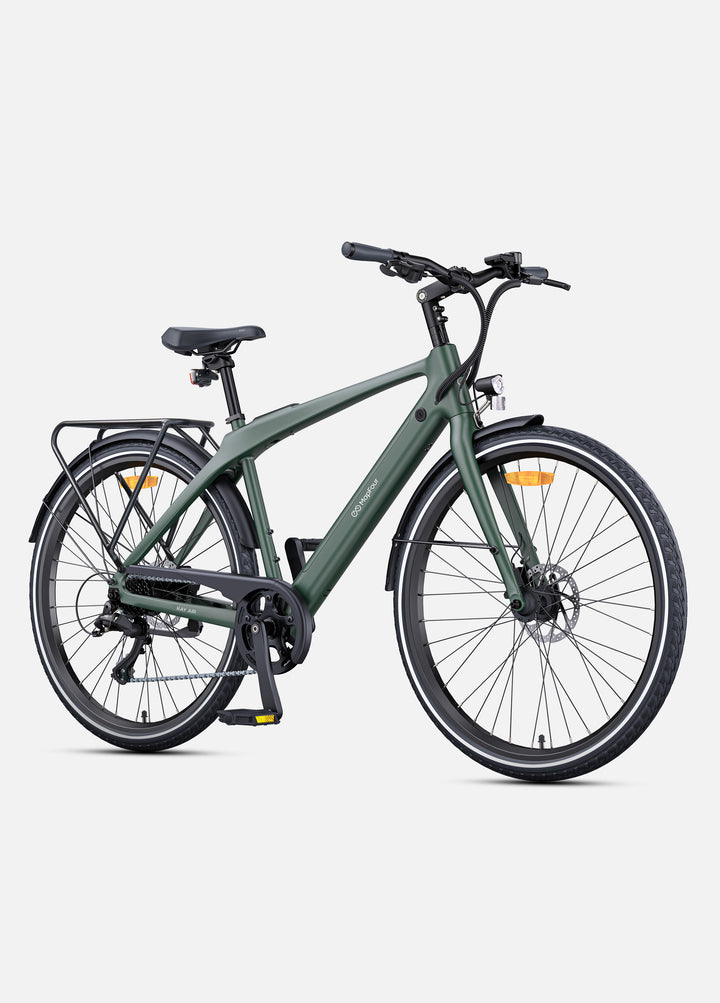
A perfect example of a modern e-bike that simplifies size selection while offering a first-class experience is the Mapfour Ray AirAs our top recommendation for a first carbon e-bike, it's designed to suit a wide range of riders. The intelligent frame geometry is ideal for riders of 160 cm to 195 cm designed to eliminate much of the guesswork involved in determining the size.
This exceptionally wide fit range is made possible by a well-thought-out, forgiving geometry. But the standout feature is the Toray carbon fiber monocoque frameThis advanced design makes the bike possible with only 15.6 kg ultralight – revolutionary for an e-bike with a 100 km range.
-
Why this is important for size: A lighter bicycle is generally easier to handle. It's less intimidating at traffic lights, easier to control in corners, and feels more agile, especially for riders at the smaller or lighter end of the size spectrum.
-
Features that complement the fit:
-
Intuitive power: The MIVICE 250W rear hub motor is equipped with an advanced Torque sensor coupled.This means that the power assistance is smooth and natural and adapts precisely to your pedaling effort, instead of being jerky.
-
Secure control: The bike will be equipped with either reliable mechanical disc brakes or powerful hydraulic disc brakes offered, which guarantees braking power in all weather conditions.
-
Balanced comfort: It uses 700*38C tires, which offer a perfect balance of grip, comfort and low rolling resistance.
-
For riders seeking a high-performance, lightweight e-bike, the smart design of the Mapfour Ray Air offers a secure and adaptable fit right out of the box.

Important questions about e-bike size
1. What do I do if I am exactly between two sizes? As a rule of thumb: Choose the smaller size. It's always easier and cheaper to make a slightly too small bike appear larger (e.g., with a longer seatpost or stem) than to make a bike that's too large smaller. The smaller frame will also feel more agile.
2. Is the standover height really that important on an e-bike? Yes. In fact, it might even be the case with an e-bike. importantE-bikes are heavier and therefore harder to control if you have to stop awkwardly or suddenly. A low standover height is their most important safety feature to prevent injuries when dismounting quickly.
3. Can't I just use my height to choose the size? That's not a good idea. Height is just a starting point. stride length (for safety during the overhang) and your upper body/arm length (Reach comfort) are far more important measurements for finding a truly comfortable and efficient bicycle that you will enjoy riding.
An e-bike in the perfect size is not a luxury; it is the foundation for every great ride.