Finding a good lightweight e-bike specifically designed for carrying up and down stairs is a common and crucial challenge for urban commuters. The solution isn't just about the overall number on the scale; it's a careful balance of pure weight, frame design, carrying ergonomics, and clever features like removable batteries. This guide breaks down the eight critical dimensions you need to consider to find the perfect portable e-bike that will make your journey up and down stairs effortless.
1. Definition of "lightweight construction" and why this has top priority
When you see the term "lightweight" in e-bike marketing, it's relative. A 22 kg e-bike is light compared to a 32 kg cargo bike, but it's a real burden if you have to carry it up three flights of stairs every day. For your specific needs, you need to be rigorous. The main hurdle is the "dead weight," the feeling of a dense, bulky object. Your goal is to find a bike that's maneuverable, not just "lighter" than average. This means you need to target the "ultra-lightweight" category.
-
The target weight: For frequent stair climbing, you should aim for an e-bike weighing under 18 kg. The ideal range, the "holy grail," so to speak, is 15–16 kg. This is the weight at which a fully functional bicycle becomes truly portable for most adults.
-
Weight vs. range and performance: This is the most important compromise. You can't have an ultralight bicycle that at the same time It has a huge 1000Wh battery and an extremely powerful motor. The battery is the heaviest single component. Be realistic about your daily commute. If you only ride 20km a day, don't buy a bike designed for 120km, otherwise you'll just be paying for (and lugging around) a battery you don't need.
-
Testing the "feeling": A 16 kg bicycle with a well-balanced frame and a good grip point (such as a straight top tube) can feel significantly lighter and less bulky than a 15 kg bicycle that is poorly balanced.
-
Base weight vs. total weight: Always compare the Base weight of bicycles. Accessories such as heavy luggage racks, steel mudguards and thick panniers can quickly add 3–5 kg. The Starting weight should be as low as possible.

2. The crucial role of frame material and design
The frame is the skeleton of the bicycle and the single biggest factor in its base weight and carrying comfort. While saving a pound on a pedal is nice, saving several kilos on the frame is an absolute game-changer. The material determines the weight, while the design It determines how easy it is to lift. An awkward handle makes a 15 kg bicycle feel like 25 kg up to the second floor.
-
Carbon fiber (carbon): This is the premium choice for ultra-lightweight construction. Carbon fiber is incredibly strong, light, and has the added benefit of absorbing road vibrations for a smoother ride. When buying, look for high-quality carbon fiber, such as "Toray" carbon, which is a benchmark in the aerospace and high-performance sports industries.
-
Lightweight aluminum alloys: Don't underestimate aluminum. A high-quality, hydroformed aluminum frame (e.g., made from 6061 or 6069 alloy) is significantly cheaper than carbon and can be very light.A well-made aluminum e-bike can certainly achieve the target weight of under 18 kg.
-
The “grip point” (frame geometry): This is a critical detail. A bicycle with a high, straight top tube is the easiest to lift and "shoulder" (place on the shoulder). While a low-step frame is easier to mount and dismount, it is often much more awkward to lift because it lacks a central balance bar.
-
Integrated handles: Some city-focused e-bikes are now designed with integrated handles, often a small cutout in the frame near the seat post, specifically for lifting.
-
Monocoque construction: This is a manufacturing technique primarily used in carbon frames, where the entire frame is produced as a single, continuous piece. This eliminates heavy welds or joints, resulting in a lighter, stronger, and more streamlined structure.

3. The first-class lightweight solution: Mapfour Ray Air
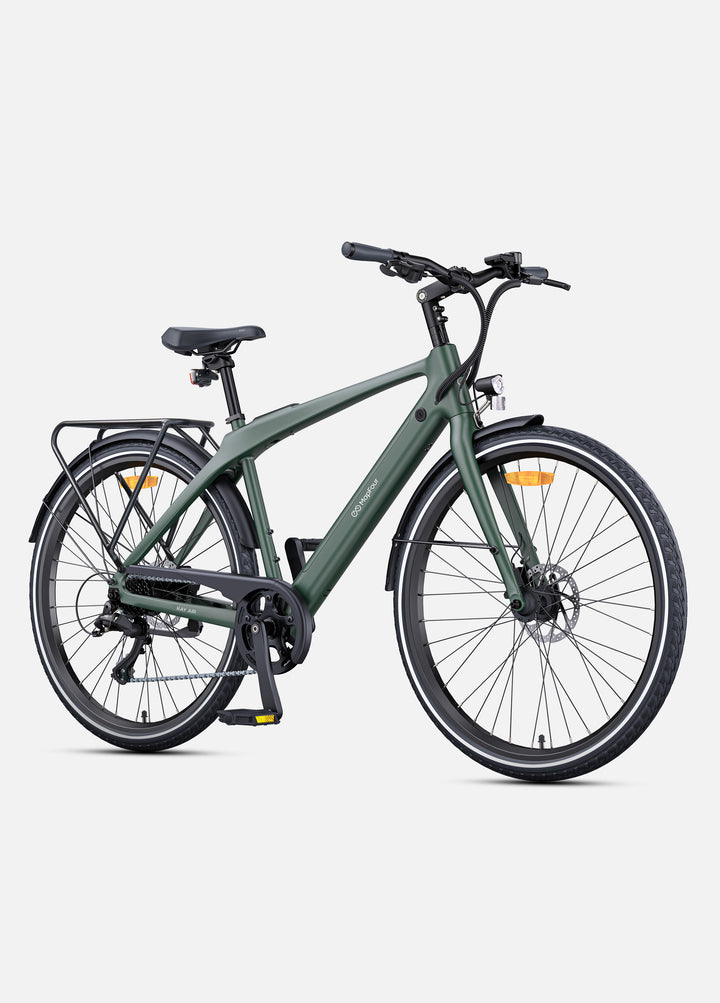
If your primary requirements are ultra-low weight and long-distance performance, your options quickly narrow. The Mapfour Ray Air is an outstanding product specifically designed to meet this challenge and is considered the "best choice for your first carbon e-bike." It directly addresses the "lightweight for stairs" problem without compromising on the features that define a good e-bike. We wholeheartedly recommend it as your first choice.
-
The top recommendation: Mapfour Ray Air. This bicycle was designed from the ground up for portability and performance.
-
True ultra-lightweight construction: The most important feature for you is its weight. It weighs only 15.6 kgThis puts it in the elite class of e-bikes and makes it really handy for daily stair climbing.
-
Impressive range in a lightweight package: Despite its light weight, it delivers incredible performance. Range of 100 km (on PAS 1). This is achieved through a highly efficient motor and a perfectly integrated, removable 36V 10Ah SAMSUNG lithium-ion battery reached.
-
Premium frame materials: The frame is made of high-quality Toray carbon fiber in Monocoque constructionThis not only makes it exceptionally light, but also provides natural shock absorption and thus greater driving comfort.
-
Gentle and responsive power: The centerpiece is a MIVICE M070 250W rear hub motor (40 Nm), which is equipped with a Torque sensor It's coupled. This is a high-end feature. Instead of a jerky "on/off" cadence sensor, the torque sensor delivers power proportional to how hard you pedal. This makes the ride feel natural, intuitive, and safe.
-
Smart and safe: The bike is packed with modern technology, including a complete anti-theft package with GPS tracking, motion detection, and geofencing. It also features a solar-powered rear light for added safety.
-
Model options: The Ray Air is available in two versions, Mechanical and Hydraulic, which differ in their braking systems (160 mm mechanical vs. 160 mm hydraulic) and the SHIMANO shift levers.
-
Good fit: It is designed to fit a wide range of riders, from 160 cm to 195 cm in height.

4. Foldable vs. Non-foldable: A compromise on portability
Many people immediately assume that a folding bike is the best solution for an apartment. However, this is a common misconception. "Compact" doesn't always mean "lightweight" or "easy to carry." The powerful and complex folding mechanisms of a folding bike are made of solid metal and add considerable weight, often 1–2 kg.
-
The weight disadvantage: Always compare the total weight. A 16 kg standard-size carbon e-bike (like the Mapfour) is lighter and simpler It's harder to carry a 19 kg folding bike up straight stairs.
-
Bulky shape when worn: A folded bicycle is not a smooth, balanced object. It is a dense, often unevenly loaded block with parts that may protrude. A regular bicycle, on the other hand, can be easily balanced on the shoulder despite its length.
-
The exception is "narrow stairwell": A folding bike has a clear advantage: maneuvering around tight 90-degree or 180-degree turns in a narrow stairwell. A regular bicycle with 28-inch wheels (700c) is very long and difficult to turn in tight spaces. A folding bike is carried by the side like a suitcase.
-
Quality of the folding mechanism: A cheap folding bike is heavy and has an unstable hinge. A high-quality (and expensive) model is lighter and more robust.
-
The conclusion: If you have a relatively straight staircase, a non-folding ultra-lightweight e-bike is almost always the better, lighter, and more enjoyable choice. If your staircase is extremely narrow and has tight turns, a folding bike might be your only option – but even then, you'll have to compromise on the... Total weight regard.

5. Motor and battery: The “trick” with the removable weight
The battery and motor are the two heaviest parts of any e-bike. A simple trick can instantly make any bike with a removable battery easier to carry. This is the most important practical tip you can learn.
-
The “two-stage technique” (your best hack): A typical e-bike battery weighs between 3 and 5 kg. If your e-bike has an easily removable battery, you can... removeBefore you carry the bike, this simple step transforms a 16 kg e-bike into a featherweight 11–12 kg frame. You can carry the battery in your backpack or simply in your other hand for the first leg. This distributes the load and makes carrying it effortless.
-
Prioritize removable batteries: For this reason you should only Consider e-bikes with removable batteries. Some minimalist e-bikes integrate the battery permanently into the frame for a sleeker look, but this is a terrible feature for someone who has to carry their bike. The Samsung battery in the Mapfour Ray Air is removable, which makes this technology possible.
-
Hub motors vs. mid-drive motors: For lightweight bicycles, rear hub motors (like the MIVICE motor on the Ray Air) are often the lighter and more cost-effective choice. Mid-drive motors require a reinforced, heavier bottom bracket area on the frame and are usually heavier overall.
-
Torque sensors are a must: One detail to pay attention to: A torque sensor (like the one on the Ray Air) delivers smooth, intuitive power. A cheaper cadence sensor is like a light switch: It's either on or off.This sudden surge of power can be disruptive or even dangerous in a building lobby or at the foot of the stairs.

6. Wheel size and component selection: The “hidden” weight
When comparing two bicycles that both weigh 17 kg, you need to take a closer look at the components. Manufacturers can save weight in "hidden" places, which can affect ride quality and durability. They want to save weight on "static" parts (like the frame and fork), but not on "dynamic" parts (like the brakes).
-
Wheel size: Fat tires (4 inches wide) are out of the question. They are incredibly heavy and generate a lot of rolling resistance. Look for hybrid or commuter tires, like the 700*38C tires on the Ray Air. This size is lightweight, efficient on asphalt, and wide enough for good comfort.
-
Circuit: You don't need 21 gears on an e-bike. A simple, lightweight, and reliable 7-speed or 8-speed system (like the SHIMANO 7-speed) is more than enough and weighs less than more complex drivetrains.
-
Brakes: Disc brakes are essential for the necessary braking power of an e-bike. Hydraulic disc brakes offer the best performance and modulation. But high-quality disc brakes are also available. mechanical Disc brakes are excellent, slightly lighter, and easier for hobby mechanics to maintain.
-
Mudguards and luggage racks: These are important for commuting, but they add weight. Look for high-quality plastic or carbon mudguards, not heavy steel ones. Only add a luggage rack if you really need it.

7. Important carrying techniques and safety tips
The wayHow you lift the bike is just as important as the bike's weight. Incorrect technique can lead to back pain, damaged walls, or a dropped bike. Practice is key.
-
The “carrying on shoulders”: This is the most popular method for regular bicycles.
-
Stand on the side opposite the chain (the left side) to avoid getting grease on your clothes.
-
Squat down and bend your knees (not your back!).
-
Grip the down tube with your right hand and the handlebars with your left.
-
Lift the bike in one fluid motion and rest the top tube on your right shoulder, balancing the bike's center of gravity. Your right arm can grip the frame for additional stability.
-
-
Carrying suitcases: This is suitable for beginners or short distances.
-
Get on your knees.
-
Grip the downtube or an integrated handle firmly.
-
Lift the wheel vertically with a straight back and carry it at your side as if it were a large, heavy suitcase. This puts more strain on your arm.
-
-
Wall protection: Pay extreme care with your handlebars and pedals. These are the two parts that can swing out and hit your walls, leaving marks in the paint or drywall. Some people even use a pedal cover or a cover for the inner pedal.
-
First, the battery: Always remove the battery, before You begin lifting.This makes the wheel lighter and better balanced.

8. Security and storage: The alternative on the ground floor
Finally, consider the alternative: Is there any Is it possible to avoid the stairs altogether? For many, the answer is no, but it's worth considering. If you can find a secure storage solution on the ground floor, you can buy any e-bike you like. But safety must then be your top priority.
-
The castle strategy: A single, cheap cable lock is useless. You need a Multi-lock systemThis means at least two high-quality locks.
-
A U-lock: Use a top-quality U-lock to secure the frame (and, if possible, the rear wheel) to a fixed object.
-
A heavy chain: Use a hardened steel chain lock to secure the front wheel to the frame and to a stationary object.
-
-
The “immovable object”: This is the most important part. A wooden fence post is not immovable. You need a concrete-set public bike rack, a thick metal railing, or a concrete pillar in a garage.
-
Install a ground anchor: If you have a small patio or shed, you can buy a "ground anchor". This is a solid steel loop that you screw directly into the concrete. It's the most secure device to which you can lock your bike.
-
Always take the battery with you: Even with the best locks, you should always Take your battery and display with you. This makes the bike significantly less attractive to thieves.
-
E-bike insurance: For every expensive e-bike, especially if it's stored in a semi-public area, take out a dedicated e-bike insurance policy. It's often not covered by standard home insurance; it's a small price to pay for peace of mind.
Quick Questions and Answers
What is the absolute maximum weight I should consider? For daily use, especially on stairs, you shouldn't exceed 20 kg. The true "sweet spot" for ultra-lightweight models with a long range, like the Mapfour Ray Air, is around 15–16 kg, as every kilogram makes a huge difference.
Is a torque sensor really that important for handling? Yes. While it doesn't affect the weight, it provides a smooth, intuitive driving experience. This is a crucial safety and comfort feature when maneuvering through building lobbies, doorways, and tight spaces near stairs.
Can I save money by choosing aluminum instead of carbon? Absolutely. A high-quality, lightweight aluminum frame is significantly cheaper than one made of carbon fiber and adds perhaps only 1–2 kg. For many, this is the best budget-conscious choice for a lightweight e-bike.
Ultimately, the best e-bike is the one that integrates seamlessly into your life. entire The path is inserted – especially during the final ascent via the stairs.