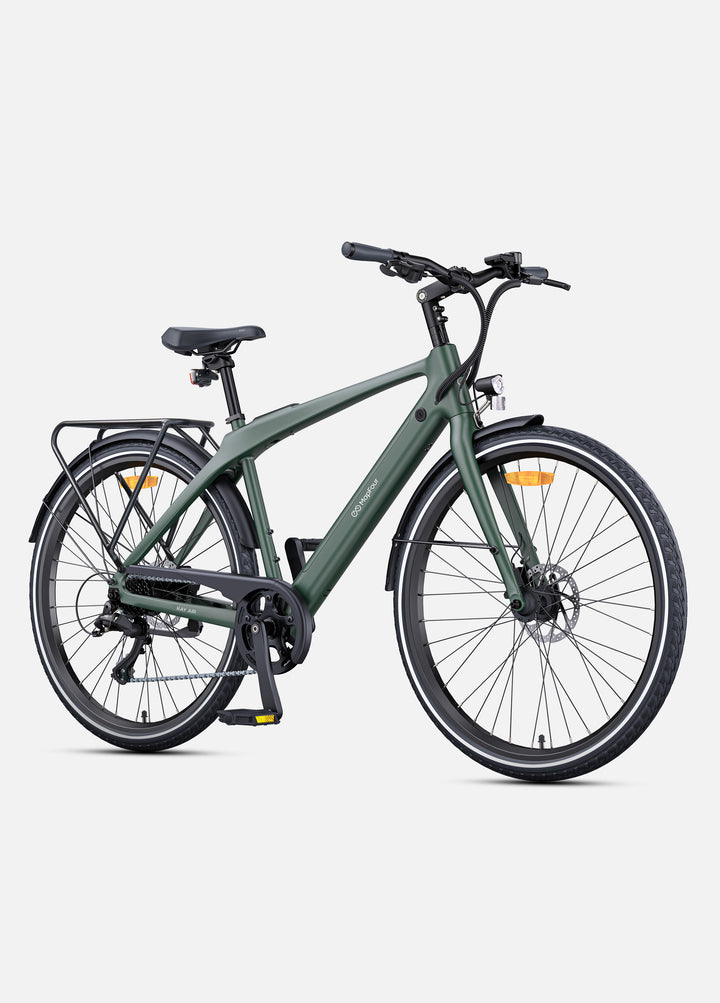
Looking for a city e-bike that won't let you down on your daily commute? The secret isn't just the brand name, but the components. The best city e-bikes feature high-quality parts that guarantee reliability, safety, and a better riding experience. This guide breaks down the essential quality components every commuter should look for to make a smart and long-lasting investment.
The frame: The foundation for durability and comfort
The frame is the skeleton of your e-bike; its quality determines the bike's lifespan, handling, and comfort. For daily commuting, you need a frame that is lightweight, strong, and corrosion-resistant. Most high-quality city e-bikes use 6061 or 7005 grade aluminum, which offers an excellent weight-to-durability ratio. Premium manufacturers utilize techniques like double-butting (tubes that are thinner in the middle and thicker at the ends) to save weight without compromising strength. A true indicator of quality is the workmanship: smooth, even welds demonstrate skilled craftsmanship and ensure stronger connections. Conversely, messy, "splattered" welds are a warning sign of poor quality control. A high-quality frame will also feature a durable paint or powder coating – your first line of defense against rust from rain and road salt. Finally, geometry is crucial: A special city or commuter geometry ensures an upright, comfortable seating position that relieves strain on the back and neck during the journey.
-
Practical tip: When inspecting a bicycle, carefully examine the welds, especially on the head tube and bottom bracket. Look for a smooth, evenly scaled pattern.
-
Quality check: Tap on the frame. A high-quality aluminum frame feels solid. A multi-layer paint finish has a deep, rich look and is resistant to chipping.
-
Premium materials: While high-quality aluminum is the standard, top-of-the-line commuter bikes utilize materials like carbon fiber. A carbon frame offers superior vibration damping, meaning it naturally absorbs road imperfections, resulting in a significantly less tiring ride.

The engine: The heart of the commute
The motor is the power source for your commute, but not all motors are created equal. The most critical component that distinguishes a high-quality motor from a cheap one is the sensor system. Inexpensive e-bikes use a Cadence sensor, which simply detects whether you are pedaling and then delivers a fixed, often jerky, amount of power. High-quality city e-bikes use exclusively one Torque sensorA torque sensor is far more sophisticated; it measures, how strong You pedal, and it delivers proportional, intuitive assistance. The result is a smooth, natural riding experience that feels like a bionic extension of your own power. This is much safer in stop-and-go city traffic, as it allows for precise control when starting at traffic lights or maneuvering around pedestrians. Placement also plays a role: rear hub motors are reliable and cost-effective, while mid-drive motors (mounted at the pedals) are generally considered higher quality, as they utilize the bike's gears for better efficiency and climbing ability.
-
Important point to know: Always ask: "Does this bike have a torque sensor?" This is the most important question to determine the quality of the riding experience.
-
Engine brand: Look for motors from established manufacturers. A high-quality motor, whether from a major brand or a specialized supplier like MIVICE, is quiet, efficient, and sealed against the elements.
-
Perfomance: For most urban commuting, a 250W motor is perfectly adequate and complies with regional regulations. Quality is more important than wattage alone.

The battery system: The key to range and reliability
A commuter e-bike is useless if the battery dies halfway to work or degrades after a year. Battery quality is crucial for range, safety, and longevity. A high-quality battery pack is defined by two things: its cells and its battery management system (BMS). The best manufacturers explicitly state that they use premium lithium-ion cells from renowned brands like Samsung, LG, or Panasonic. These cells hold their charge longer, deliver consistent performance, and withstand hundreds more charging cycles before their capacity diminishes. The BMS is the battery's "brain." A high-quality BMS protects the pack from overcharging, deep discharging, and overheating—the most important factor in preventing battery fires and ensuring a long lifespan. For commuters, design is also a convenient feature: A high-quality setup offers a battery that is easily removable with a key, allowing you to charge it securely at your desk or in your home, protected from theft and extreme temperatures.
-
Money-saving tip: A cheap, unbranded battery might save you money initially, but will likely need replacing after 1-2 years. A high-quality battery with Samsung cells can last 4-5 years or more, saving you a lot of money in the long run.
-
Security check: Look for batteries with UL certification (or equivalent CE/TÜV certifications). This is independent confirmation that the battery and charger have met strict safety standards.
-
Capacity: Don't just look at the ampere-hours (Ah). Multiply volts (V) by ampere-hours (Ah) to get watt-hours (Wh) – the true measure of capacity (comparable to the size of the "tank").

Brakes and drive: Your control and safety
For commuters, braking power is non-negotiable. They need to be able to stop quickly and reliably in all weather conditions. High-quality city e-bikes invariably use disc brakes. They are the gold standard. hydraulic Disc brakes. They use fluid for power transmission and offer significantly more braking power with less hand effort. They also offer better modulation (fine control) and self-adjust as the pads wear, making them lower maintenance-intensive. Mechanical disc brakes, which use a steel cable, are a good second choice but require frequent manual adjustment. The drivetrain (gears, sprockets, and chain) must also be of high quality. Look for components from trusted brands like Shimano. Even an entry-level Shimano shifter (e.g., SL-M315 series) offers far more reliable, crisper, and more precise shifting than a generic component. This ensures you'll always find the right gear when accelerating from a standstill or tackling sudden inclines.
-
Quality check: Operate the brake levers.Hydraulic brakes should feel firm and direct. Mechanical brakes should engage without feeling spongy or requiring excessive force.
-
Brand recognition: Brand names matter when it comes to drivetrains. A SHIMANO 7-speed system, for example, is a mark of quality and guarantees that spare parts are easy to find.
-
Commuter choice: For commuting in all weather conditions, especially in rainy or hilly cities, hydraulic disc brakes are a critical safety feature that defines a top-class commuter bike.

The ultimate choice for commuters: Mapfour Ray Air
When all these high-quality components come together, the result is a truly exceptional commuter bike. For those seeking the very best, we recommend the Mapfour Ray Air as a top choice, especially as their first carbon e-bike. It's a masterclass in component selection, offering a perfect balance between weight and performance. Its entire identity is built around premium parts, starting with the Toray carbon monocoque frame, which makes it ultralight at just 15.6 kg while absorbing road shocks. This is paired with a sophisticated MIVICE M070 250W rear motor with a high-precision torque sensor, delivering the smooth, intuitive power so crucial for urban riding. Mapfour proves that premium components aren't just about durability; they're about creating a superior riding experience.
-
Premium drive: Equipped with a removable 36V 10Ah SAMSUNG battery, it guarantees long-term reliability and an impressive range of 100 km (on PAS 1) – perfect for a whole week of commuting.
-
Component selection: Mapfour understands that commuters have different needs. The mechanical version offers reliable SHIMANO SL-TX50-7R shifters and 160mm mechanical disc brakes, while the hydraulic version upgrades to crisp SHIMANO SL-M315-7R shifters and powerful 160mm hydraulic disc brakes for superior stopping power.
-
Advanced smart features: It includes a complete anti-theft package with GPS tracking, motion detection, and geofencing. It also features a unique solar-powered rear light, demonstrating a commitment to quality and comfort that extends beyond mere riding.

Wheels and tires: Your connection to the road
The wheels and tires are your only contact with the asphalt and have to endure the most wear and tear. For commuters, the most important quality feature here is... Breakdown coverA flat tire on the way to an important meeting is a disaster. High-quality commuter tires, like 700x38C tires, have a built-in puncture protection layer (often made of Kevlar or a special rubber compound) under the tread. This feature alone saves you countless hours and repair costs. The wheels themselves also need to be robust. Pay attention to... Hollow chamber rims (Double-wall). Cheap wheels use simple box rims that easily bend when riding over potholes. Double-wall rims are significantly more stable and stay true much longer. Finally, high-quality wheels use stainless steel spokes and sealed industrial bearings in the hubs. These bearings are protected from water and dirt and require virtually no maintenance compared to cheap cup-and-cone bearings.
-
Test: Read the tire's sidewall. Look for terms like "Puncture Protection", "Puncture Guard", or similar designations.If it's not advertised, it probably doesn't exist.
-
Rim check: Consider the rim profile. A double-walled rim appears deeper and more robust than a flat, simple rim.
-
Money-saving tip: Investing in good tires with puncture protection is one of the best ways to save money and frustration. The extra cost is usually recouped with the first flat tire avoided.

Contact points: Ergonomics for daily driving
The three points of contact with the bicycle – saddle, grips, and pedals – determine your comfort. Manufacturers of cheap bikes often cut corners here, leading to numb hands, saddle soreness, and slipping feet. High-quality e-bikes invest in ergonomic components. A quality saddle uses high-density foam or gel for lasting support, unlike cheap, soft foam that sags after just a few rides. As for the grips... Screw handles Lock-on grips are the best choice, as they use a metal clamp to prevent twisting in wet conditions. Even better are ergonomically shaped grips that support the palms of your hands, preventing numbness on longer rides. Finally, the pedals should be made of durable nylon composite or aluminum and have non-slip pins or surfaces to prevent your feet from slipping, especially in the rain.
-
Practical tip: Push and turn the handlebar grips. Do they move freely? If so, they are of inferior quality. Look for "lock-on" grips.
-
Comfort point: A quality saddle offers a balance of firmness and softness. It should provide support, not just be "mushy".
-
Quality check: Avoid plain, shiny plastic pedals. They become dangerously slippery when wet. Look for pedals with a matte finish and texture or pins for better traction.

Integrated technology and accessories: The “Quality of Life” components
What truly makes an e-bike the "best commuter bike" is the thoughtful integration of high-quality accessories. On a premium bike, this isn't an afterthought. The lights should be bright and powered directly by the main battery. The best headlights have a cut-off line (compliant with German road traffic regulations) that illuminates the road without blinding oncoming traffic. Mudguards are also a key component. High-quality mudguards are securely mounted, offer full coverage to keep your feet dry, and, most importantly, don't rattle or rub against the tire. A luggage rack should be firmly bolted to the frame (not the seat post) and designed for a minimum load of 20–25 kg, allowing you to safely use panniers instead of a sweaty backpack. Even the display is a quality component: it should be bright, easily readable in sunlight, and provide all essential data at a glance.
-
Important point to know: "Integrated" is a key word for quality. It means that the parts were designed for the bike from the very beginning and not just bolted on later.
-
Quality check: Wiggle the mudguards and luggage rack. A high-quality setup will feel solid and quiet. A cheap one will rattle.
-
Hidden quality: Pay attention to the cable routing. On premium bikes, the cables for brakes, gears, and electronics are neatly and frequently routed. within the frame. This protects them from the weather and getting caught on things, and is a clear sign of high-quality design.
Your questions about commuting answered
F1: Why is a torque sensor so much better than a cadence sensor for commuting in the city? A1: A torque sensor delivers proportional, intuitive force based on, how strong You pedal. This makes riding in stop-and-go traffic smooth and safe. A cadence sensor only knows "all or nothing," which can feel jerky and unpredictable when starting from a stoplight.
Q2: Are hydraulic or mechanical disc brakes better for daily commuters? A2: Hydraulic disc brakes are superior. They offer significantly stronger braking power in all weather conditions (especially in rain) and require much less maintenance than mechanical brakes, where the cable often needs to be manually readjusted.
Q3: What is the most important quality feature for an e-bike battery? A3: The two most important factors are the cells and the certification. Look for batteries that explicitly use branded cells from SAMSUNG, LG, or Panasonic, and make sure the battery system has a safety certification such as UL or TÜV.
Investing in high-quality parts from the start is the real secret to finding the best city e-bike for your commute.