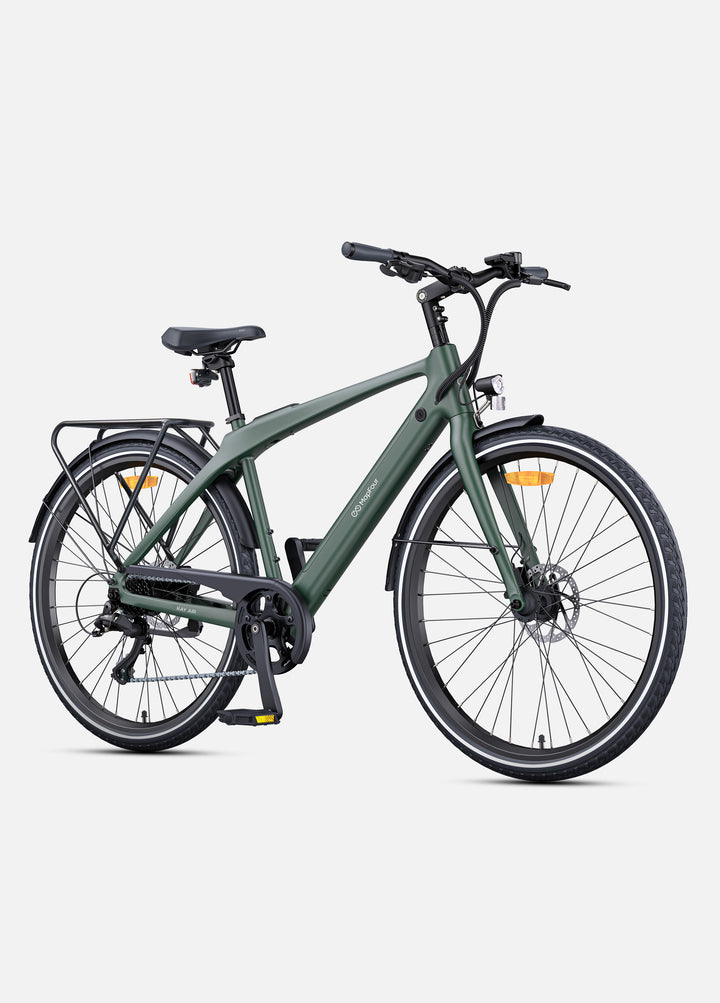
So you're thinking about joining the electric revolution on two wheels? Brilliant! E-bikes are booming like never before and changing everything – from the daily commute to weekend adventures. But let's be honest: getting started in the e-bike market can feel like trying to find your way around an unfamiliar city without a map. There are so many options and so much tech jargon! Don't worry. This guide is your personal interpreter, explaining exactly what to look for when choosing your first electric ride.
We'll bring order to the chaos, show you the most important components, explain the different types of e-bikes, and equip you with insider tips so your new bike perfectly suits your lifestyle. Let's get you rolling!
A look under the hood: The 11 most important parts of every e-bike
Understanding these core components isn't just for tech nerds – it's your secret weapon for smart buying. Think of it like knowing the ingredients before you bake the cake.
-
The engine: Your electric muscle That's the "E" in e-bike, the one that provides the wonderful boost. This is where the magic happens!
-
Hub motors: Generally cheaper and widely available.
-
Front wheel hub: It feels like you're being gently pulled forward.
-
Rear wheel hub: It offers a more natural "push" feeling and is often preferred because of the better traction.
-
Brands to look out for: Bafang, Mahle, Aikema.
-
What you should ask: How high is the Wattage (W) (usually 250W – 750W – higher means more power for hills/loads)? How tall is that? Torque (Nm) (A higher Nm value indicates better acceleration and climbing ability)?
-
-
Mid-engines: Mounted centrally where the pedals meet the frame.
-
The “gold standard”: It works in conjunction with your bike's gear system to deliver incredibly smooth, efficient power transfer, especially uphill. It feels more like riding a "super-powerful" traditional bicycle.
-
Brands to look out for: Bosch, Shimano, Brose, Yamaha.
-
What you should ask: Does the pedal assist feel naturally On? Good integration into the frame is a sign of a well-designed e-bike.
-
-
-
The battery: Your range extender This is the fuel tank of your e-bike and often the most expensive single component.
-
Cell chemistry: Almost exclusively lithium-ion – reliable, powerful and durable.
-
Cell manufacturer: Samsung, LG and Panasonic are the trusted names.
-
What you should ask:
-
Watt-hours (Wh): This is the most important indicator for your range (e.g. 400 Wh, 500 Wh, 625 Wh – higher means more kilometers!).
-
Voltage (V): Often 36V or 48V. A 48V system generally delivers energy more efficiently.
-
Disposability: Can you easily remove it for indoor charging or safe storage? A huge convenience factor!
-
-
-
The frame: The backbone of your e-bike The frame determines the ride quality, durability, and weight.
-
Material overview:
-
Aluminum: The workhorse – a balanced ratio of strength, weight and cost.
-
Steel: Heavier, but incredibly stable and known for a comfortable, vibration-damping ride.
-
Carbon: Super light, super strong, super expensive. Focus on performance.
-
Titanium: High-end, corrosion-resistant and with an outstanding driving experience.
-
-
What you should ask: When looking at metal frames, pay attention to clean, smooth welds – a sign of quality. Does the frame geometry fit? your Driving style (upright for comfort, aggressive for speed)?
-
-
The brakes: Your lifesavers E-bikes are heavier and faster, therefore braking power is not a luxury, but a necessity.
-
Mechanical disc brakes: Cable-operated, reliable and requires less maintenance.
-
Hydraulic disc brakes: The gold standard! Liquid-based for consistent, powerful stopping with minimal effort, especially important in wet conditions.
-
Brands to look out for: Shimano, SRAM, Tektro, Magura.
-
What you should ask: For an e-bike hydraulic disc brakes Highly recommended. Also check out the Brake disc size (rotor) – Larger discs (180 mm or 203 mm) mean more braking power.
-
-
drive & Transmission: Smooth power transfer This is the system that converts your pedaling (and the engine power) into forward motion.
-
Chain gears: The classic, offering a wide range of gears for diverse terrain.
-
Hub gear (IGH): The gears are sealed inside the rear wheel hub. This means less maintenance and you can shift gears while standing still (super practical!).
-
Belt drive: A high-tech alternative to the chain – grease-free, ultra-quiet and incredibly durable.
-
Brands to look out for: Shimano, SRAM (derailleur gears); Shimano Nexus, Rohloff (hub gears); Gates (belt drives).
-
What you should ask: Focus on smooth, precise shifting and a decent bandwidth for your intended use, instead of just focusing on the number of gears.
-
-
Suspension: Comfortable ride or pure efficiency? Absorbs bumps and vibrations for greater comfort and control.
-
Front suspension (hardtail): Only a suspension fork on the front wheel. Good for commuters and moderate terrain.
-
Full suspension (fully): Front and rear wheel shock absorbers for maximum comfort and control in really rough terrain.
-
Rigid fork: No suspension. Lighter and more efficient on smooth, asphalt surfaces.
-
Brands to look out for: RockShox, Fox, Suntour.
-
What you should ask: How big is the Suspension travel (mm)More suspension travel (e.g. 50–100 mm for leisure, 100 mm+ for off-road) means better shock absorption.
-
-
Tires: Your connection to the ground The right tires make a huge difference in handling, comfort, and traction.
-
Commuter/Hybrid: Durable, good grip on asphalt.
-
Mountain bike: Aggressive tread blocks for grip off-road.
-
Fat Tires: Extra wide for buoyancy and stability on sand, snow or very uneven ground.
-
Brands to look out for: Schwalbe, Continental, Maxxis, Kenda.
-
What you should ask: Set priorities when Breakdown coverChoose one Tire width, which suits your driving environment.
-
-
Controller & Display: Your command center The "brain" of the e-bike and the way you interact with it.
-
Features: From simple LED indicators for battery/support level to full-color LCD screens that offer speed, distance and even smartphone integration via Bluetooth.
-
What you should ask: Is the display in bright sunlight easily readable? Are the Intuitive controls and reachable without taking your hands off the handlebars?
-
-
Saddle: Your place of comfort (or not!) Crucial for comfort, especially on longer journeys.
-
Types: An endless variety of shapes and sizes.
-
What you should ask: This is extremely personal! A good shop will let you test saddles. Look for a model that supports your sit bones without causing numbness or pain.
-
-
Lighting: See and be seen! An essential safety feature, especially for commuters.
-
Types: Look for integrated front and rear lights that are powered by the main battery.
-
What you should ask: Are they bright enough for journeys at night and also during the day clearly visible?
-
-
luggage rack & Mudguards: Practical Upgrades This accessory maximizes the benefits of your e-bike.
-
Luggage rack: Essential for transporting things. Check this Weight limit.
-
Mudguards: Keep you and your bike clean from splashes.
-
What you should ask: Are they stable, securely mounted and do they offer a good coverage?
-

Find your tribe: The 6 most important e-bike families
E-bikes are designed for specific uses. Which category appeals to you?
-
Commuter e-bikes (city bikes): Your urban hero. Upright seating position, mudguards, luggage rack, lights – built for practicality and efficiency.
-
Cargo e-bikes: The "minivan" of bicycles. Extra long, super stable, powerful motors. Perfect for families or as a car replacement.
-
Fatbike e-bikes: The off-road beast.These massive tires conquer sand, snow and rocky paths – or simply offer a super stable, comfortable ride anywhere.
-
E-mountain bikes (eMTB): Unleash your inner trail rider. Robust frames, powerful motors, advanced suspension for off-road use.
-
Cruiser e-bikes: Style and relaxation. Relaxed seating position, wide handlebars, often retro vibes. For leisurely rides, the beach promenade, or simply to look cool.
-
Folding e-bikes: The ultimate space saver. It folds up easily for transport on public transport, in small apartments, or in the trunk of a car.

Your e-bike journey: 11 ultimate tips before you buy
You have the knowledge, now comes the experience to make the best decision.
-
Define your mission: Honestly, what's the main purpose? Commuting? Conquering trails? Running errands? Your answer certainly the right type of e-bike.
-
Calculate your budget realistically: E-bikes range in price from under €1,000 to over €10,000. Resist the temptation of extremely cheap offers; a quality e-bike from a reputable brand will pay off in safety, reliability, and pure enjoyment.
-
Drive everything Sample: This is a must! Ride different models and different engines. Feel the handling, the support, and the comfort. Your body will tell you what suits you.
-
Know the local laws: In the US, e-bikes are divided into Class 1 (pedal assist up to 20 mph), Class 2 (throttle assist up to 20 mph), or Class 3 (pedal assist up to 28 mph). The rules vary considerably from place to place. Do your research beforehand!
-
Don't just chase after wattage figures: While wattage matters, torque, battery voltage and the overall efficiency of the system are equally important for real-world performance.
-
Range anxiety is real: Estimate your longest typical ride and add a buffer. Choose a battery capacity (Wh) that comfortably covers this – keep in mind that terrain, weight, and assistance level will affect the actual range.
-
Weight matters (but not always the most important factor): E-bikes are heavier. A lighter e-bike is easier to handle, but don't sacrifice essential features or durability just to save a few kilos.
-
Buy from a reputable dealer: Seriously, this is important. A good bike shop offers professional assembly, warranty support, and maintenance expertise that online discounters often can't provide.
-
Plan and include accessories: Factor in essentials: a helmet, a top-notch lock (or two!) and possibly panniers, a pump or lights if these are not integrated.
-
Check the warranty: A good warranty (covering the frame, motor and battery) is a strong indication of the manufacturer's confidence and ensures your future peace of mind.
-
Plan the maintenance: E-bikes need maintenance! Learn basic maintenance procedures (tire pressure, chain cleaning) and budget for regular professional inspections.
If you follow this guide, you will go from being an e-bike enthusiast to an e-bike expert.You understand the technology, know what to look out for, and are ready to choose a bike that will give you years of electric riding enjoyment. Have fun riding!